

Indicators Your Industrial Boiler Needs Expert Servicing
share
Industrial boilers are fundamental to production and facility operations. Ensuring their safe and reliable performance is a critical business necessity. Delayed or inadequate industrial boiler servicing can lead to significant operational risks, including costly downtime, safety hazards, and premature equipment failure.
Our blog today helps facility managers and engineers identify the early boiler repair warning signs and understand when to service industrial boiler systems to maintain dependable, long-term performance.
Factors Affecting Industrial Boiler Performance and Longevity
An industrial boiler is a long-term asset capable of reliable operation for up to 30 years. However, this lifespan is directly influenced by several key factors that proper industrial boiler servicing routines are designed to manage:
- Water Quality
Untreated water introduces suspended solids and gases that accelerate corrosion and scale formation. Dissolved oxygen can cause severe pitting corrosion in tubes, and just 0.8mm of scale can result in 8% heat loss and a 2% increase in fuel consumption.
- Operating Conditions
Most industrial boilers are designed for optimal performance between 12-30 PSI. Exceeding design pressure or temperature limits creates excessive strain and shortens service life.
- Installation Standards
Even premium boilers with exceptional materials perform poorly if improperly installed. Professional installation ensures correct connections and adherence to manufacturer specifications.
- Soot and Combustion Byproducts
Soot accumulation results in 47% heat loss and requires 8.5% more fuel, forcing boilers to work harder while delivering less heat.
Top Signs Your Industrial Boiler Needs Servicing
Recognizing boiler repair warning signs early can prevent catastrophic failures and unplanned shutdowns. Operators should watch for these critical indicators:
1. Elevated Stack Temperatures
A rising flue gas temperature without a corresponding change in the boiler’s firing rate is a clear sign of boiler inefficiency. This typically indicates that heat is not being transferred correctly to the water. The most common causes are soot buildup on the fireside or scale formation on the waterside. Both act as insulators and reduce heat transfer.
2. Unusual Operating Noises
Boilers should operate with a consistent and familiar sound. Clanging, rattling, hissing, or deep rumbling noises need immediate investigation. They can signal loose components, sludge accumulation, or unequal water distribution causing localized overheating (kettling).
3. Water Leaks or Visible Moisture Around the Unit
Leaks indicate a breach in the system, which can lead to pressure loss or accelerated corrosion on external components. Continuous water loss forces the unit to consume more makeup water, increasing fuel and water treatment costs.
4. Delayed or Inconsistent Heat Output
If the boiler is slow to respond to heating demands or struggles to reach its set-point temperature, the internal components may be damaged. This is especially common in older units where scale or sludge impairs heat transfer efficiency.
5. Odors Coming From the Boiler Room
Unusual smells, such as burning metal, rotten eggs (mercaptan additive in gas), or smoke, indicate potentially dangerous conditions. These odors can signal gas or oil leaks or improper combustion.
6. Rising Energy Bills Without Increased Demand
A sudden or gradual increase in fuel consumption that’s not explained by increased production is a classic sign of reduced boiler efficiency. This is often linked to internal issues like soot or scale buildup, which force the boiler to work longer and harder to produce the same amount of heat. Tracking energy bills is a practical way to monitor for these boiler repair warning signs.
These signs apply to all types of systems, from steam boilers to hot water boilers. Monitoring and controlling these parameters is managed by modern burner and boiler control systems.
Industrial Boiler Maintenance Checklist: Daily, Monthly, and Annual Tasks
A structured boiler maintenance checklist is essential to any preventative maintenance strategy:
Daily Tasks
- Monitor the water level in the sight glass.
- Record pressure gauge and temperature readings.
- Check the operation of the low water cutoff (LWCO) to ensure the burner shuts down at low water levels.
- Drain the gauge glass to remove any rust and debris.
- Observe the burner response during control operations.
- Perform a bottom blowdown to remove sludge and sediment.
- Visually inspect the burner refractory for any visible damage.
Monthly Tasks
- Test all limit controls and flame detection systems.
- Check the blowdown separator for correct operation
- Inspect floor drains to ensure they are clear and functioning.
- Verify that air inlet screens are clean and unobstructed.
- Test all safety and operating valves.
Annual Professional Servicing
The cornerstone of a professional industrial boiler servicing program and should be conducted by qualified technicians:
- Disassemble and inspect low water cutoff devices for sludge, corrosion, or switch defects.
- Verify and tune burners using professional combustion analysis.
- Inspect the fireside for soot and the waterside for scale or corrosion; clean all surfaces completely.
- Perform hydrostatic testing to check for leaks at tube joints and piping connections.
- Inspect refractory material for cracks or broken sections.
- Replace or recertify all safety relief valves as required by regulations.
- Conduct a flue gas analysis test to optimize combustion efficiency.
- Test all electrical terminals and control systems.
- Lubricate pumps and motors according to manufacturer specifications.
How EEA Supports Safe and Reliable Boiler Operations
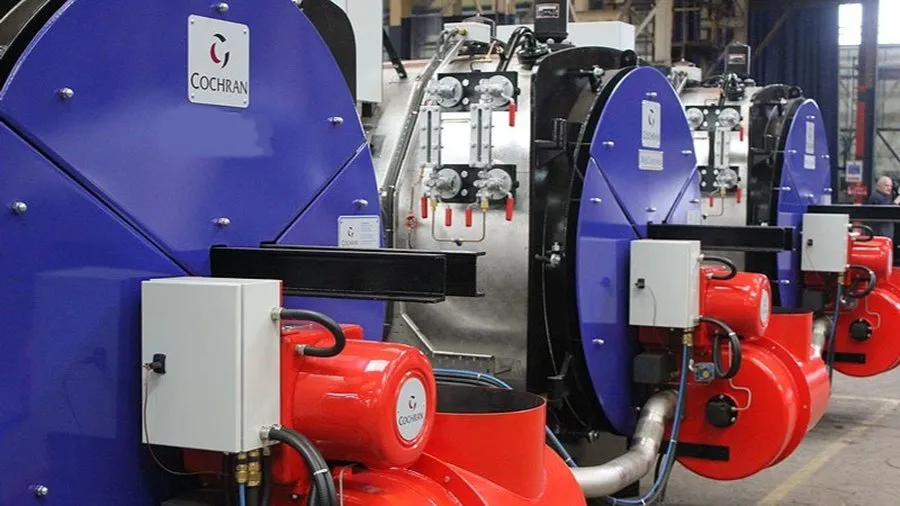
Egyptian Engineering Agencies (EEA) is the exclusive agent for Cochran, a manufacturer of industry-leading industrial steam and hot water boilers with over a century of expertise. This equipment is supported by our full range of engineering services, from initial consultation and installation to long-term industrial boiler servicing and maintenance.
- Steam Boilers: The Cochran ST32 Steam Boiler offers outputs from 18,000 to 40,000 kg/hr, with a net efficiency of up to 95%. It also features a horizontal three-pass wet-back design and low-NOx burners
- Hot Water Boilers: The HW34 Hot Water Boiler delivers output ranging from 5,000 to 16,000 kW, with twin-furnace designs available for 30,000 kW. Features include fully wet-back construction, low NOx burners, and a 7:1 turndown ratio. The HW29 Hot Water Boiler provides compact, energy-efficient operation for commercial and industrial applications.
- Heat Recovery Systems: The ST95 Packaged Heat Recovery Boiler captures excess heat from industrial processes (gas turbines, reciprocating engines, incinerators) and converts it into steam or hot water for facility use or external sale. Available in single, twin, or triple stream configurations with full compliance to BS EN 12953 and Pressure Equipment Directive (PED) standards.
- Burner and Boiler Control: We supply Autoflame Mk8 MM Controllers that provide boiler management through a 12.1-inch touchscreen interface. These systems reduce fuel consumption, cut CO2 emissions by 10%, and feature automated flame safeguards enabling unmanned boilerhouse operation.
- Flue Gas Analysis Equipment: EEA provides portable flue gas analyzers for real-time combustion analysis, emissions monitoring, and boiler tuning to optimize efficiency and ensure environmental compliance.
Selected EEA Industrial Boiler Projects in Egypt
EEA’s engineering capability is demonstrated in its successful project completions across Egypt’s key industries.
Coca-Cola HBC Turnkey Steam Supply: EEA delivered a comprehensive steam supply system featuring a Cochran steam boiler, high-efficiency burners, and Autoflame controls to ensure maximum efficiency for their production facility.
5-Star Red Sea Hotel Hot Water Boilers: EEA successfully commissioned two hot water boiler rooms at a premier Egyptian resort, providing a reliable heating and hot water supply for high-demand hospitality operations.
Industrial Steam Boiler Plant: EEA has completed the installation of numerous industrial steam boiler plants designed to serve manufacturing and processing applications, demonstrating a deep understanding of industrial requirements.
Keep Your Industrial Boilers Safe and Efficient
Proactive industrial boiler servicing is an important business function that protects your investment and employee safety. By learning to recognize the boiler repair warning signs and implementing a consistent boiler maintenance checklist, facility managers can maximize boiler lifespan and optimize energy performance.
EEA’s portfolio of Cochran boilers, combined with advanced Autoflame controls and comprehensive maintenance support, provides Egyptian factories with world-class heating solutions.
Explore tailored solutions for your facility with EEA. Contact us today.