

Selecting the Right Industrial Vacuum Cleaner for Your Facility in Egypt
share
What an industrial facility removes from its environment is just as important as what it produces. The cleaning demands of an auto service center differ from those of a textile plant, just as the dust profile in a ceramics factory varies from what’s found in mechanical workshops. Each application has its own unique operational requirements, safety standards, and types of debris.
As premier distributors of industrial vacuum systems in Egypt, EEA helps facilities select equipment that matches their actual on-site conditions.
Our industrial vacuum cleaner selection guide in Egypt outlines key factors to consider and offers application-based recommendations to help you choose the right solution for your facility.
How Industrial Vacuum Selection Affects Performance and Safety
Industrial environments are not all uniform; what works for a small assembly line may fail under the conditions of a cement plant, textile mill, or car wash facility. Especially where airborne dust, mixed debris, and long operational hours are common, a general-purpose vacuum often falls short of expectations.
Selecting the right industrial vacuum cleaner depends on more than just suction power; there’s also the need to match the facility’s workload, debris type, and duty cycle. When those factors are misaligned, the result is premature filter clogging, inefficient cleaning, or unscheduled downtime.
Choosing the appropriate industrial vacuum cleaner helps maintain air quality, protect surrounding equipment, and minimize cleaning-related disruptions —a technical decision with a direct impact on safety and long-term operating costs.
Key Factors for Selecting an Industrial Vacuum
1. Type of Debris and Materials
Each industry produces its unique waste profile, and a vacuum system must be tailored to match it. Ceramic manufacturers and construction sites, for example, deal with abrasive dust. Textile plants handle lightweight fibers that can clog filters easily. Automotive workshops deal with oil, coolants, and mixed debris.
Models like the TMB-A58.3 are better suited to large particulate or chip collection, while the TMB WETA27 supports mixed wet/dry applications in tighter service spaces.
2. Power and Performance Requirements
Vacuum cleaners should sustain performance under continuous use, handling dense materials, or high-volume debris collection. Underpowered systems may operate initially but would degrade quickly under strain, leading to overheating and frequent maintenance.
EEA’s industrial vacuum range includes both single-phase and three-phase vacuums to accommodate different infrastructure and application levels. Lighter-duty units, such as the TMB DRYP12, are suitable for light service operations. Three-phase models, like the TRI30S, are designed for continuous high-volume work, offering 3000W of power, 348 m³/h of airflow, and 32 kPa of vacuum pressure.
3. Filtration and Air Quality
The quality of filtration directly affects the purity of indoor air and the reliability of equipment. Textile facilities require wide-surface filters to reduce clogging from synthetic fibers, while chemical environments demand sealed anti-static designs.
PICCOLO models offer a silent and more compact filtration system suited to small workshops or non-industrial zones (homes, small shops, and hotels). The TRI30S industrial vacuum cleaner features a 4,300 cm² filter surface and a radial design in its stainless-steel version, making it suitable for handling harsh airborne contaminants.
4. Tank Size and Efficiency
Investing in a large industrial vacuum cleaner can significantly reduce cleaning interruptions and the frequency of maintenance. Especially in facilities that handle large volumes of debris or operate in multiple shifts.
The TRI30S industrial vacuum cleaner has an 80-liter tank that makes it ideal for continuous or heavy-duty cleaning. Smaller models, such as the DRYP12 and PICCOLO, are designed for limited spaces where maneuverability takes precedence over capacity.
5. Mobility, Noise, and Integration
In guest-facing sectors like hospitality or multi-use service areas, lightweight and quieter vacuums, such as the WETA27 or PICCOLO, are more suitable. In contrast, fixed or cart-mounted units with reinforced frames are better suited to plant floors or large production halls.
EEA’s lineup includes some of the best industrial vacuums on the market, designed to perform reliably in environments where uptime and safety are non-negotiable.
6. Maintenance & Local Support
When selecting an industrial vacuum cleaner, the focus is primarily on technical specs like the airflow, tank size, filtration, and maneuverability. But long-term performance is just as dependent on how the system will be maintained and supported over time.
A) Ease of Serviceability
Look for models with accessible filter compartments and service ports that allow for quick inspections or replacement of parts; this reduces downtime and makes routine maintenance more efficient.
B) Filter Replacement Cycles and Costs
Some vacuums require frequent filter changes, especially when handling fine particles. Before selecting a model, you need to evaluate:
- How long filters typically last under your expected load
- The cost and availability of replacement filters
- Whether the system supports washable or reusable filter options
These factors directly affect the total cost of ownership and ongoing operational reliability.
C) Support Availability in Egypt
Imported equipment without local support leaves facilities vulnerable to prolonged lead times and unscheduled downtime. EEA addresses this by offering:
- Local stock of critical spare parts
- Certified service teams trained on TMB systems
- Responsive maintenance support throughout Egypt
For facilities with continuous shifts or remote locations, this local coverage ensures that technical issues don’t turn into operational delays.
D) Total Lifecycle Planning
Finally, selection should factor in long-term upkeep:
- What is the expected maintenance schedule?
- Does the supplier offer documentation, support plans, or training?
- Can the system scale or be serviced alongside others already in use?
Matching Industrial Vacuums to Application Type
The selection process is more straightforward when you align vacuum features with the conditions of each industrial factory. These are typical applications across Egypt’s industrial sectors and features to look for in each case:
Manufacturing and Mechanical Workshops
Vacuums here must handle abrasive debris, resist oil exposure, and perform reliably under continuous operation. Three-phase units with larger tanks and sealed motors are preferred to reduce overheating and filter saturation.
Automotive and Car Wash Facilities
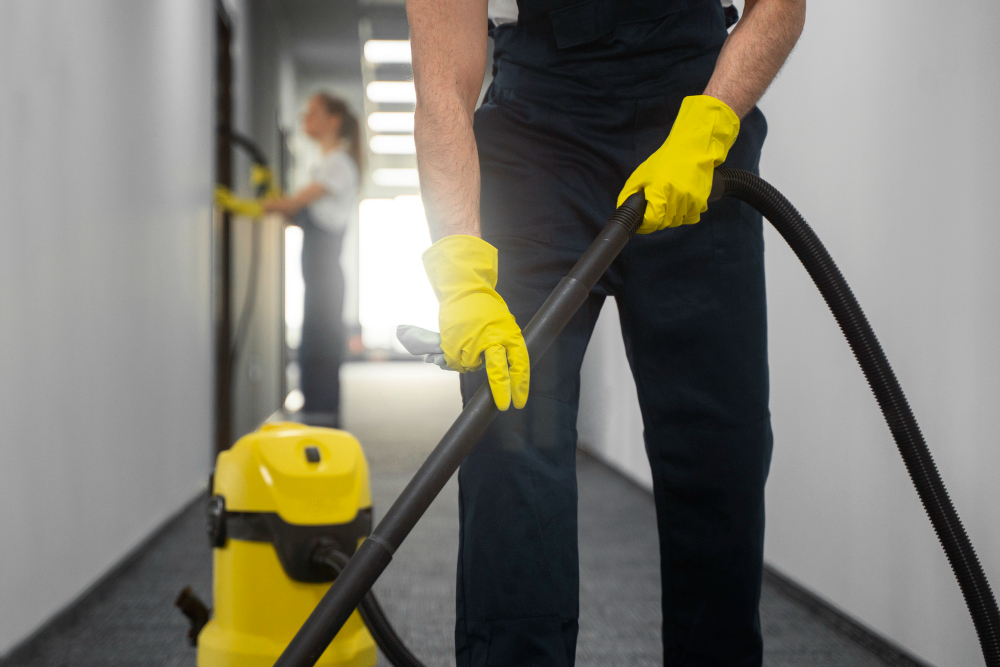
A mix of wet and dry materials from upholstery dust to floor liquids requires flexible, mobile systems. Wet/dry capacity, maneuverability, and easy filter access are key selection points. Central vacuum systems are also used in car wash facilities, which reduce noise at individual work areas and help maintain a cleaner, more organized facility environment.
Textile Industry
Larger surface filters and anti-static features help prevent clogging from fine, fibrous debris. In these facilities, airflow consistency and minimal maintenance cycles take priority over tank size or raw suction power.
Chemical and Pharmaceutical Facilities
The primary concern here is containment. Vacuums must support high-efficiency filters (Class M or higher), corrosion-resistant housings, and sealed collection compartments. Regulatory requirements often guide selection.
Ceramic and Construction Sites
Fine, abrasive dust requires durable machinery and aggressive filtration. Vacuums need to run for extended periods without breakdown and should be easy to service and capable of managing high particulate loads. These sectors often require certified dust collection systems in Egypt that can handle abrasive particles without compromising air quality or equipment longevity.
Hospitality and Commercial Facilities
Noise levels, storage footprint, and ease of movement take precedence over suction capacity. Smaller, quieter vacuums with adequate filtration are typically sufficient unless the facility includes industrial kitchens or laundry areas.
EEA: Trusted by Egyptian Industries for Over 80 Years
Egyptian Engineering Agencies has supported Egypt’s industrial sector since 1941, combining certified equipment with hands-on technical expertise. As premium distributors of industrial vacuum systems in Egypt, we ensure that each machine is installed on-site, configured to meet the facility’s specific needs, and supported from day one.
Post-installation, our clients benefit from structured maintenance agreements for all equipment we supply. Our maintenance contracts include routine monthly visits with a dedicated team of 20 engineers and 40 technicians operating nationwide.
In-house training is also available, helping teams operate vacuum systems safely and efficiently. Installation, maintenance, repair, and training are all delivered by globally backed local experts.
Reach out to EEA for expert guidance on selecting, installing, and maintaining the right industrial vacuum cleaner for your facility.