

How Laser Cutting is Revolutionizing Sheet Metal Fabrication
share
Sheet metal fabrication is a cornerstone of industrial production, shaping everything from automotive bodies to structural steel. For decades, mechanical cutting methods like shearing and punching defined the industry’s limits on speed and accuracy. Today, manufacturing relies on advanced laser cutting technology that delivers unmatched precision and accuracy.
Through our exclusive partnership with global leaders HACO, Egyptian Engineering Agencies (EEA) brings this state-of-the-art capability to manufacturers across Egypt. In this blog, we’ll explore how sheet metal laser cutting is revolutionizing the industry through superior precision, waste reduction, accelerated production, and expanded creative possibilities across countless sectors.
- Unmatched Precision in Metal Cutting
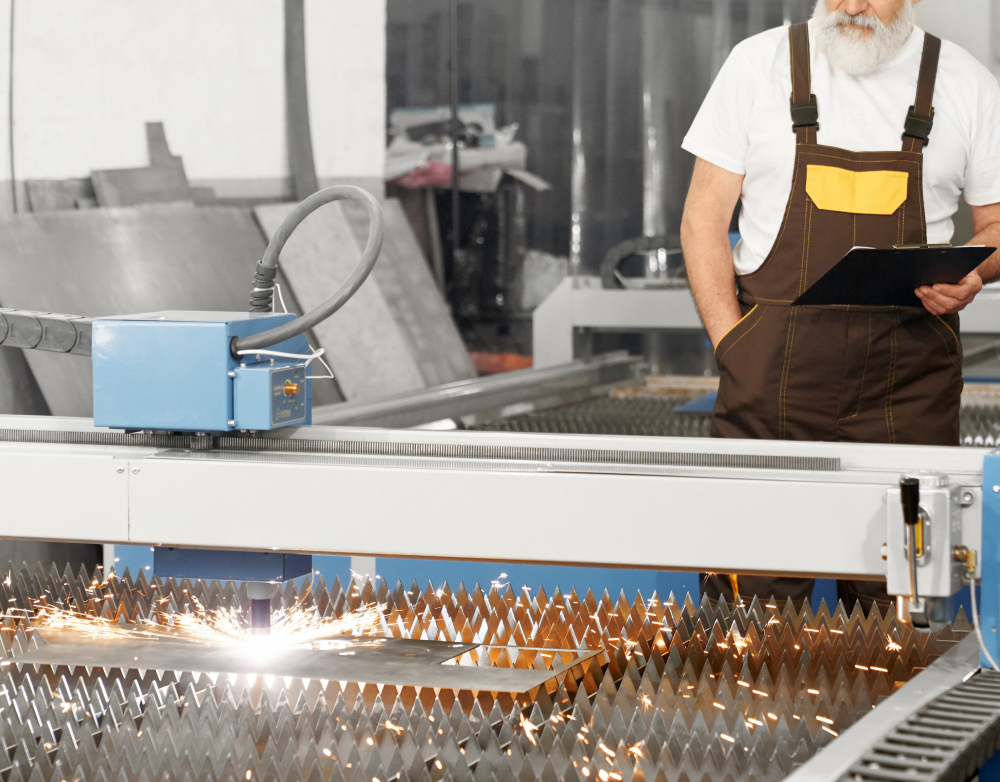
The primary advantage of laser cutting for sheet metals is its ability to deliver accuracy that traditional methods can’t match. The laser metal cutting process works by focusing a high-intensity light beam to melt, burn, or vaporize material in a highly localized and controlled area. Modern fiber laser systems can concentrate this energy into a beam as narrow as 25 microns (roughly one-quarter the width of a human hair). This focus enables cutting tolerances as fine as ±0.05 millimeters, allowing for the production of complex components with exact repeatability from batch to batch.
Another advantage of laser cutting for sheet metals is the superior edge quality it produces. The process creates smooth, sealed edges with a minimal Heat-Affected Zone (HAZ). The HAZ is the area of the material whose properties were altered by intense heat. A smaller HAZ preserves the metal’s structural integrity, preventing unwanted hardening, softening, or micro-cracks that could compromise performance and durability.
- Reducing Waste and Maximizing Efficiency
Material utilization has always been a concern in sheet metal fabrication, particularly when working with high-value alloys like stainless steel, aluminum, and titanium. Traditional cutting methods often yield wide kerfs and excessive scrap. Laser cutting for sheet metal directly addresses this challenge in two ways:
- First, the laser beam’s narrow kerf (the width of material removed during cutting) removes far less material per cut.
- Second, this technology works in tandem with advanced nesting software, which uses complex algorithms to optimize how parts are arranged on a sheet.
This combination can increase material utilization rates to over 90% and reduce scrap generation by up to 8% compared to conventional methods. This translates into substantial savings on raw materials and a reduced environmental footprint.
The efficiency gains also improve quality control. When parts are cut accurately on the first pass, there is no need to discard defective components. This reduces downtime and ensures production lines remain on schedule. In high-volume environments, these gains accumulate into a significant competitive advantage.
- High-Speed Production with CNC Laser Cutting
Laser systems combine precision with remarkable speed. Fiber lasers can cut thin sheets at rates of up to 150 millimeters per second, and advanced machines can operate 10 to 50 times faster than traditional methods.
This high-speed performance is further enhanced by automation. A modern CNC laser cutting machine features integrated automated loading and unloading systems, allowing for continuous, 24/7 operation with minimal human intervention. And because the laser beam does not physically wear down, there is no tool wear, so no tool changes are required.
The result is a production line that delivers more parts in shorter cycles, meeting the demands of industries where deadlines are tight and quality must be consistently maintained.
- Versatility Across Materials and Applications
One of the defining strengths of sheet metal laser cutting is its ability to handle a wide range of materials. Modern fiber laser systems can cut carbon steel, stainless steel, aluminum, brass, copper, and specialized alloys with equal precision and accuracy. Power levels can be matched to the requirement, too. From entry systems cutting a few millimeters of sheet to advanced machines capable of processing steel up to 50 millimeters thick.
This flexibility makes laser cutting a suitable choice across various industries:
- Automotive: Fast, precise production of body panels, chassis components, and electronic housings.
- Aerospace: Cutting titanium and high-strength aluminum alloys where tight tolerances and material integrity are mission-critical.
- Construction: Fabricating structural steel elements and custom decorative facades with complex geometries.
- Medical: Producing sterile, burr-free components for medical devices where precision and cleanliness are non-negotiable.
Because a single machine can switch seamlessly between materials and thicknesses, manufacturers can avoid the need to invest in multiple dedicated systems. This reduces cost and broadens the scope of possible applications.
HACO & EEA: Global Technologies with Local Expertise
As the exclusive distributor of HACO in Egypt, EEA provides local manufacturers with access to one of the world’s most advanced laser cutting platforms. HACO, founded in Belgium in 1965, has evolved from a family-owned business into a global machine tool manufacturer recognized for its innovation and quality.
HACO’s portfolio includes high-performance fiber laser machines engineered for various production needs:
HFL-CEW (Dual-Table Fiber Laser)
- Design: A fully enclosed flatbed fiber laser with dual interchangeable tables for continuous production.
- Laser Power Options: 3 kW, 6 kW, 12 kW.
- Table System: Two automated exchange tables for uninterrupted cutting cycles.
- Connectivity: Real-time process monitoring, Industry 4.0 ready.
- Safety: Fully enclosed cabin with pneumatic doors and operator light-curtain protection.
HFL-CEG (Sheet & Tube / Combi Laser)
- Design: A hybrid system that processes both flat sheets and tubes in a single machine.
- Laser Power Options: 1 kW to 12 kW.
- Functions: Combines flat sheet cutting and tube/profile cutting.
- Tube Capacity: Diameters 20-230 mm, lengths up to 6.5 meters.
- Applications: Ideal for workshops requiring flexibility between sheet metal and tubular components.
HFL-C (Compact Single-Table Fiber Laser)
- Design: A space-saving solution that delivers full HFL cutting performance in a smaller footprint.
- Laser Power Options: 1 kW to 12 kW.
- Table System: Single sliding table with front motorized access.
- Performance: Rigid frame for high precision and fast cycle times.
- Safety: Fully enclosed cutting area with motorized doors for safe loading.
EEA’s Local Expertise & Delivered Projects
Technology alone does not guarantee performance; it must be implemented correctly and supported over its lifecycle. At EEA, we have proven this through successful integrations of CNC laser cutting machines for many of Egypt’s leading industrial companies:
Egyptian-Japanese for Building and Construction (EJAB)
EEA successfully installed a suite of advanced machines, including a Press Brake, Shear, Fiber Laser, and Multi-Steel Worker. Our team provided comprehensive training to ensure optimal operation and maintenance, empowering EJAB’s workforce with the skills needed for continued success.
Advanced Machinery Installation for ICPM Company
EEA installed a Press Brake, Shear, and Fiber Laser for ICPM Company. We delivered comprehensive training to ensure their team possesses the technical expertise to maximize the efficiency and capabilities of these cutting-edge machines, demonstrating our commitment to empowering businesses with state-of-the-art technology.
With a dedicated team of 20 engineers and 40 trained technicians supported by 14 fully equipped vehicles, EEA provides installation, maintenance, breakdown repair, and in-house training. This ensures that each machine continues to perform at peak reliability long after it is commissioned.
Explore how sheet metal laser cutting can transform your production capabilities.