

The Benefits of Multi-Axis CNC Machines for Complex Manufacturing
share
Global supply chains demand repeatable quality, and local industries must improve efficiency to remain competitive against international standards. In this demanding environment, conventional machining methods limit what production teams can achieve.
Multi-axis CNC machines provide a practical solution for this challenge. By allowing controlled movement across multiple linear and rotational axes, these systems enable advanced machining in fewer setups while maintaining high dimensional accuracy.
In this blog, we’ll explain how these machines operate, how they reduce setup time, and how they differ from standard CNC systems. We’ll also provide an overview of our specialized CNC machinery portfolio, which supports precision manufacturing in Egypt.
Understanding Industrial Multi-Axis CNC Machines
CNC machining relies on programmed control of cutting tools to remove material with accuracy. A standard 3-axis machine moves along three linear directions:
- X-axis for left-to-right movement.
- Y-axis for front-to-back movement.
- Z-axis for vertical movement.
This configuration suits many general tasks. But complex manufacturing usually requires access to multiple angled features or deep cavities that are difficult to reach with linear motion alone.
Multi-axis CNC machines can do that by adding rotational axes. A 4-axis system introduces rotation around one axis (the X-axis, known as the A-axis). This allows the workpiece to rotate during machining. A 5-axis system adds a second rotary axis (typically the B-axis). These additional axes enable the cutting tool to approach the part from multiple orientations within the same setup.
Instead of removing a part, re-clamping it, and re-aligning coordinates, the machine adjusts its orientation automatically through programmed motion. In industrial environments such as aerospace, automotive, energy, and heavy equipment manufacturing, this capability supports:
- Machining of angled and contoured surfaces.
- Consistent dimensional control across multiple faces.
- Reduced manual intervention during production.
- Creation of single-piece components rather than assembled parts.
The Benefits of Multi-Axis CNC Machines in Complex Manufacturing
In complex manufacturing environments, setup time directly affects productivity and the final cost per part. Each time the operator unclamps and repositions a workpiece, they introduce the risk of misalignment and dimensional variation.
Multi-axis CNC machines reduce these risks by enabling single-setup machining. With additional rotational axes, the machine automatically reorients the workpiece or cutting tool under CNC control. This allows multiple angles and contours to be machined without manual repositioning.
The operational impact is measurable in several ways:
- Fewer Fixturing Cycles: Operators don’t need to pause production to manually rotate parts.
- Reduced Calibration: Less time is spent recalibrating coordinates between cuts.
- Lower Cumulative Error: Eliminating manual repositioning removes a primary source of tolerance deviation.
- Continuous Operation: The spindle continues machining while the machine internally adjusts orientation.
EEA’s Multi-Axis CNC Machine Tools Portfolio
EEA has operated in the Egyptian engineering sector since 1941. We have built long-standing relationships with global manufacturers to bring advanced CNC technology to the local market. We are the exclusive distributor of Serdi, HACO, and Pedrazzoli equipment in Egypt:
Serdi Single Point CNC Valve Seat Machine
Serdi is the French worldwide leader in cylinder head valve seat machining, with over 40 years of experience and patented air-cushion centering technology.
Technical Specs & Features:
- Machining process: Single Point CNC with CNC-controlled Z-axis and U-axis (cutting tool radius), powered by high-dynamic Siemens servomotors
- CNC control: Siemens 840dsl with Sinamics S120 drives and multi-touch HMI screen
- Centering technology: Patented triple air cushion system with 30% floating mass reduction over previous generations
- Spindle: Built-in Swiss-made synchronous motor-spindle with maximum torque from 0 to 3,000 RPM
- Dimensions: 2,800 × 1,400 × 2,400 mm; Net weight: 1,500 kg
- Applications: Automotive, motorcycle, heavy-duty, marine, racing, and stationary engine cylinder heads.
HACO Pressmaster Hydraulic CNC Press Brake
Founded in Belgium, HACO is a globally renowned CNC machine manufacturer and pioneer in advanced metalworking machinery, offering solutions spanning press brakes, laser cutters, plasma machines, and machining centers.
Technical Specs & Features:
- Backgauge: 4-axis CNC backgauge system (X-R-Z1-Z2) with ball screws and linear guideways as standard
- Control: FASTBEND-3D MT with 24″ multi-touch screen for intuitive 3D programming
- Energy efficiency: Variable Inverter Drive (VID) for reduced power consumption
- Applications: Precision bending and shaping of sheet and plate metal for enclosures, panels, chassis, structural components, and custom metal fabrication.
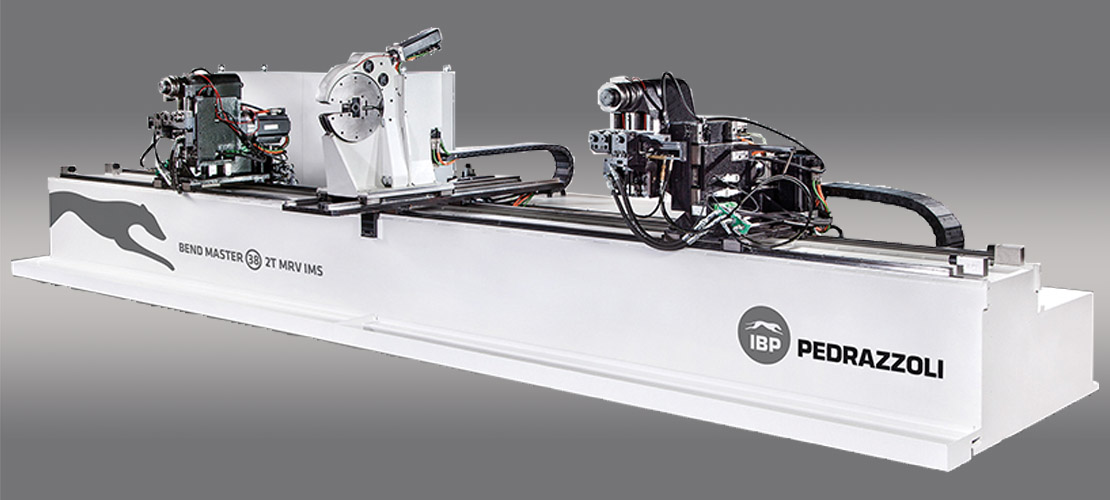
Pedrazzoli Tube Bending Machine
Pedrazzoli is a leading Italian manufacturer of tube-processing machinery serving the automotive, aerospace, nautical, HVAC, healthcare, and other sectors.
Technical Specs & Features:
- Electrically controlled axes: 8 axes, including translation and rotation
- Bending capability: Clockwise and counter-clockwise bending in the same cycle; symmetrical, asymmetrical, multi-radius, and variable radius bending
- Additional features: Automatic tool adjustment, torque-controlled clamp/pressure die, automatic workpiece lubrication, safety light barriers with programmable work zone
- Applications: Tube and pipe bending for automotive, aerospace, HVAC, construction, furniture, and general fabrication.
HACO ATPL Plasma Cutting Machine
Technical Specs & Features:
- Cutting range: 0.5 mm to 80 mm thickness
- Axes: Precision linear guides for X, Y1, Y2, and Z axes
- Drive system: Double-sided AC servo motorization
- Plasma source: Hypertherm (air or high definition with True Hole technology)
- Additional features: Automatic height adjustment via arc voltage, integrated extraction table with CNC-programmable sections, magnetic crash protection, optional bevel cutting
- Applications: Industrial metalwork, structural steel fabrication, precision cutting of electrically conductive materials.
The Vertical Machining Center (VMC)
Vertical Machining Centers typically operate on three axes but can be configured with 4-axis or 5-axis rotary tables. This adaptability allows manufacturers to transition to multi-axis CNC machines as production requirements become more complex.
General Capabilities:
- Operations: Milling, drilling, boring, tapping, reaming, and contouring
- Axes: 3-axis standard; can be equipped with a linear guide or Z axis
- Human-friendly design, a sleek front door, and large side windows (door width: 1100 mm) for convenient cleaning and easy maintenance.
- high spindle speeds 12000 rpm
Supporting Long-Term Operational Success
We understand that Multi-axis CNC machines are significant investments. To protect these assets throughout and beyond the warranty period, we provide routine maintenance through customized contracts. This agreement includes monthly visits and covers all equipment provided by us.
Our engineering and automotive services department comprises 20 specialized engineers, 40 highly trained technicians, and 14 maintenance vehicles, all fully equipped with tools and spare parts. Our goal is to achieve customer satisfaction during every service visit.
We offer a comprehensive suite of services to ensure your production remains uninterrupted:
- Installation: Professional setup and alignment of CNC systems.
- Maintenance: Scheduled checks to prevent wear and ensure accuracy.
- Repair Breakdown: Rapid response to restore machine functionality.
- In-house Training: Educating your staff on machine operation and safety.
Reach out to our team to discuss your project requirements or request a consultation.